
Think You Have Leadership Consensus? Ask These Two Questions.
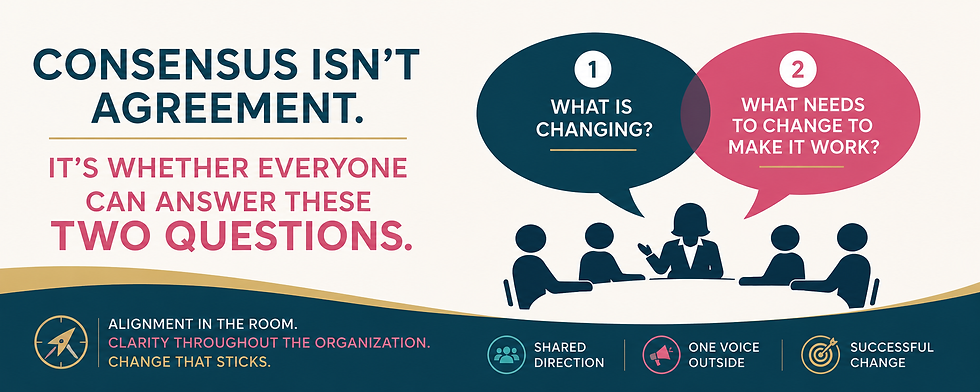
One of the biggest misconceptions I see is that leadership teams believe consensus means everyone must agree on every detail before moving forward. It doesn’t.
In effective leadership teams, consensus means something much simpler:
We’re committed to the same direction.
We’ll support the decision publicly.
We won’t undermine it after we leave the room.
People don’t have to think the decision is perfect. They simply need to believe it’s the right decision for the organization and commit to making it successful.
Align on What Matters Most
Before any major change begins, every senior leadership team should be able to answer three questions the same way:
Why are we making this change now?
In what direction are we asking the organization to move?
Who owns leading this change?
Different opinions about implementation are healthy. Different answers to those three questions are dangerous.
Debate Inside. Unity Outside.
It's surprisingly common for leaders to nod around the conference table, then explain the decision differently the next morning. I've seen it happen too many times to count.
The executive conference room should be the place where disagreement happens.
Challenge assumptions.
Ask difficult questions.
Pressure-test the strategy.
Once the decision is made, employees should hear one message. Not six.
When leaders continue debating the decision in hallways, staff meetings, or one-on-one conversations, employees immediately sense uncertainty. They begin interpreting the change through individual leaders instead of through the organization’s strategy.
As you probably already know, confusion spreads long before the change does.
Your Managers Are Your Reality Check
Executive alignment is only the first step. The real test comes when the message reaches your supervisors and managers.
If I gathered a random group of them in a room and asked two simple questions. I call these the Two Readiness Questions. Before I evaluate any organization's readiness for change, I ask:
What is changing?
What needs to change to make it work?
…would I hear the same answer from everyone? Or would I hear several different versions?
These two questions tell me almost everything I need to know about your organization’s readiness for change.
Managers are the bridge between strategy and execution. If they can’t clearly explain what is changing and what needs to change to make it work, employees won’t be able to either.
Consensus isn't measured by what executives say in the boardroom. It's measured by what managers repeat in the hallway. If they can all answer the same two questions, you're probably ready. If they can't, you have alignment work to do before you launch.


Comments